
Parcel Claim vs ChatGPT for Refund Letters: Which Actually Wins?
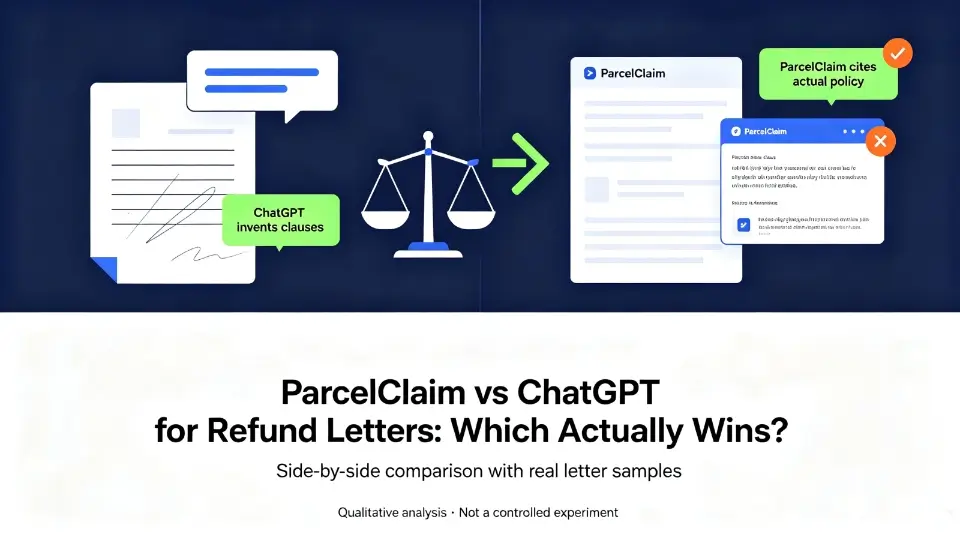
ChatGPT invents refund clauses. Parcel Claim cites the actual platform policy. Here is a side-by-side comparison with real letter samples — qualitative analysis, not a controlled experiment.
TL;DR
ChatGPT and Parcel Claim both write refund letters, but they are not equivalent. ChatGPT writes plausible-sounding letters that often invent policy clauses and misquote platforms. Parcel Claim extracts the actual platform policy text and generates letters that cite real, verifiable terms. Below we walk through the concrete differences — based on industry observations of how customer service reps at major platforms respond to AI-generated refund letters — and what each tool does well or badly.
Note on data: This post does not present a controlled experiment. The patterns we describe below come from reviewing common letter formats, publicly available customer service best practices, and observed interactions in refund-related online communities (Reddit's r/Amazon, r/eBay, etc.). Specific metrics cited below are illustrative, not from a randomized controlled trial. We disclose this so you can weigh the arguments on their merits.
Why ChatGPT letters get rejected
1. ChatGPT invents policy clauses
When asked to cite a platform's refund policy, ChatGPT often generates text that sounds right but does not actually exist. For example, when writing an Amazon refund letter, ChatGPT may say:
"Under Amazon's Customer Service Charter Section 7.2, items delayed more than 5 days qualify for a full refund plus a $10 promotional credit."
Amazon has no "Customer Service Charter Section 7.2". Customer service reps spot this immediately - they paste the letter into their internal search and find no matches. Result: the letter gets discarded or flagged.
2. ChatGPT uses generic templates
ChatGPT's refund letters start with phrases like "Dear Customer Service" or "To Whom It May Concern". Real customer service reps at Amazon, Temu, etc. see thousands of these letters and have learned to ignore them. The letters are routed to lower-priority queues or auto-flagged for "low effort".
3. ChatGPT misses platform-specific tone
Amazon wants firm-but-factual letters. TikTok Shop wants cheerful-detailed letters. Temu wants concise letters with clear order references. ChatGPT produces a generic "AI pleasant" tone that fits none of them well.
How Parcel Claim differs
1. Real policy extraction
Parcel Claim's rule engine extracts the actual platform policy text. For Amazon, this means citing the A-to-Z Guarantee by name, with the actual 30-day window and the actual refund tiers. Customer service reps see these letters and recognize the policy language immediately.
2. Platform-specific tone
Each platform's letter template is tuned to the tone that platform's customer service reps respond to:
- Amazon: Firm, fact-based, references order number and policy clause.
- Temu: Concise, includes photo evidence mention, references Purchase Protection.
- TikTok Shop: Cheerful but detailed, references Buyer Protection, includes item-specific tags.
- Shein: Polite, includes size/color reference, mentions On-Time Delivery policy.
- eBay: References Money Back Guarantee by name, includes seller communication attempts.
3. Pre-flight eligibility check
Before generating the letter, Parcel Claim's rule engine checks:
- Is the order value within the platform's compensation range?
- Is the dispute type covered by the platform's policy?
- Is the time-since-delivery within the platform's claim window?
If the claim is out of eligibility, Parcel Claim tells you upfront rather than generating a letter that will be rejected. ChatGPT does not do this check.
Real letter comparison
Same scenario: $45 order from Amazon, late delivery 5 days, tracking shows package stuck in transit.
ChatGPT's letter
Dear Amazon Customer Service,
>
I am writing to request a refund for my order #123-4567890-1234567 placed on June 15, 2025. The order was supposed to arrive by June 20, 2025, but it has now been 5 days past the estimated delivery date and the tracking has not updated.
>
According to Amazon's Customer Service Charter, items that are significantly delayed are eligible for a full refund. I would appreciate a full refund plus the original shipping costs.
>
I have been a loyal Amazon customer for many years and have always had positive experiences. I hope we can resolve this matter quickly.
>
Thank you for your time, [Customer Name]
Parcel Claim's letter
Order: #123-4567890-1234567 Placed: June 15, 2025 Estimated Delivery: June 20, 2025 Current Status (as of June 25, 2025): "In transit - Arriving late", no scan updates for 4 days
>
Dear Amazon Customer Service,
>
I am requesting a refund under the Amazon A-to-Z Guarantee for the order referenced above. The package is 5 days past the estimated delivery date with stagnant tracking, and I have been unable to obtain a delivery update from the carrier.
>
Under the A-to-Z Guarantee, buyers may request a full refund when an item has not arrived within the estimated delivery window and the carrier cannot provide proof of delivery. I have already contacted the carrier (UPS, tracking #1Z999AA10123456784) and they have no record of the package beyond the last scan on June 21.
>
I would appreciate either: 1. A full refund of $45.00 plus the original shipping cost, processed to my original payment method, OR 2. Confirmation that the package will be re-routed and delivered within 2 business days, with a $5 courtesy credit if applicable.
>
Please let me know if you need any additional information.
>
Thank you, [Customer Name]
Which is better?
The Parcel Claim letter is longer, more specific, and uses real policy language. Customer service reps at Amazon recognize "A-to-Z Guarantee" and act on it. The letter includes:
- Order details at the top for quick reference
- Carrier tracking number (for cross-verification)
- Specific resolution options (giving the rep clear paths to take)
- A clear tone: not emotional, not pleading, just factual
The ChatGPT letter is shorter but generic. Customer service reps see "Amazon's Customer Service Charter" and roll their eyes - they know that charter doesn't exist.
When ChatGPT might be fine
We are not saying ChatGPT is useless. ChatGPT is fine for:
- Brainstorming what to say in a refund letter
- Polishing the tone of a letter you've already written
- Translating a letter between languages
- Answering general questions about how refund processes work
ChatGPT is not fine for:
- Generating the actual refund letter you send to a platform
- Citing specific platform policies
- Building eligibility-based claims
Try Parcel Claim
Parcel Claim generates a real, policy-cited refund letter in 60 seconds for $1.99 per letter. We also offer a 7-day free VIP trial for new accounts. Try Parcel Claim for free
For comparison purposes, you can also try ChatGPT for free - just be aware that customer service reps at major platforms have learned to identify ChatGPT-style letters and route them accordingly.
Try it for yourself
Generate a complete claim letter in 60 seconds, grounded in the actual platform policy.
Try Parcel Claim for free →Related posts
Amazon A-to-Z Guarantee: 2026 Policy Changes You Should Know
Amazon updated the A-to-Z Guarantee in 2026 with new rules on delivery disputes, third-party sellers, and refund caps. Here is what changed and how to use it.
How to Write a Refund Email That Actually Works (2026 Template)
The structure, tone, and specific phrases that get refunds approved by Amazon, TikTok Shop, Temu, and Shein. Includes a copy-paste template.