
When to File a Credit Card Chargeback Instead of a Refund Request (2026)
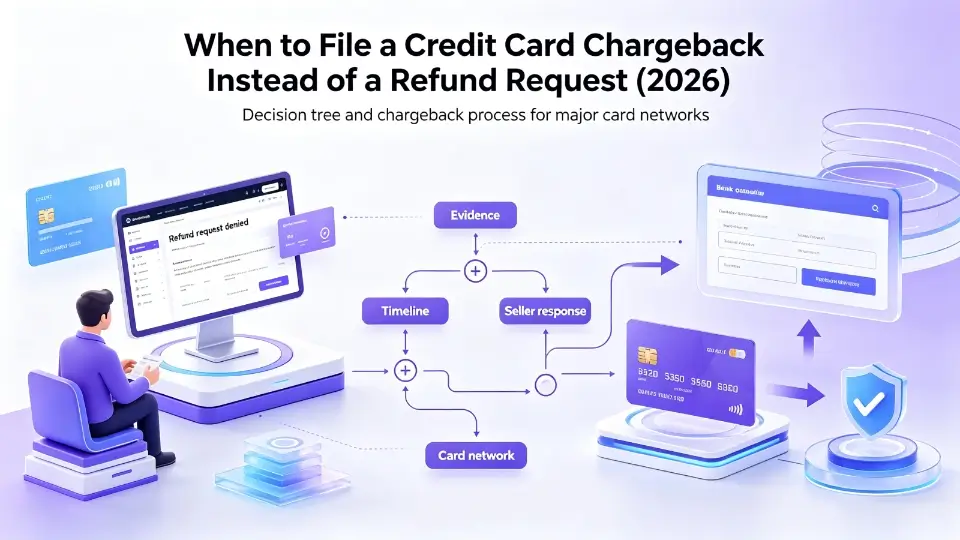
Sometimes a chargeback is faster and more effective than a platform refund request. Here is the decision tree, the chargeback process for Visa/Mastercard/Amex/Discover, and when chargeback beats refund.
TL;DR
A platform refund and a credit card chargeback are two different dispute processes. The platform refund is faster (often days), but the chargeback has more leverage (Visa/Mastercard rule in your favor in many cases). Most buyers should try the platform first, then escalate to chargeback if the platform denies. Here is when each one makes sense.
Platform refund vs. chargeback
| | Platform refund | Credit card chargeback | |---|---|---| | Who decides | Platform's customer service team | Your credit card issuer (bank) | | Time to resolution | A few days to a couple of weeks | 1-2 months (longer) | | Decision rate in your favor | Varies, often moderate | Higher for clear cases (item not received, damaged, counterfeit) | | Limits | Per platform policy (often $2,500 for Amazon) | Per purchase amount (up to your credit limit) | | Risk | Low — platform may restrict future purchases | Low — but excessive chargebacks can flag your account | | Best for | Quick resolution, clear-cut cases | Denied by platform, large purchases, fraud |
When chargeback beats refund
1. The platform denied your claim unfairly
If you provided clear evidence and the platform still denied, chargeback is your next step. The credit card company reviews the case independently and may side with you.
2. The seller or platform is unresponsive
If your messages are ignored for over a week, chargeback shifts the dispute to a more powerful party — the credit card network.
3. The purchase was over your platform's dispute limit
Some platforms have maximum dispute values (Amazon's A-to-Z was historically capped at $2,500, though this varies by category). For purchases above the limit, chargeback is your only option.
4. You bought from a seller who has now disappeared
If the seller is no longer reachable and the platform can't force them to respond, chargeback can recover the funds directly from the merchant's bank.
5. The platform itself is the merchant
For direct purchases (not marketplaces) — e.g., buying from Amazon directly, not a third-party seller — chargeback and refund are essentially the same process, but chargeback has more leverage with the merchant's bank.
When to NOT use chargeback
1. The platform refund is still in progress
Most credit card issuers will deny a chargeback if there's an active platform dispute. Wait for the platform's final decision before charging back.
2. The platform's policy explicitly excludes your situation
Some dispute types (e.g., buyer's remorse for non-defective items) are not covered by credit card chargebacks. Read the network rules.
3. The purchase is outside the chargeback window
Most credit cards allow chargebacks within 60-120 days of the original purchase date (varies by issuer). If you're outside this window, the chargeback will likely be denied.
4. You want to keep the item AND get a refund
Chargeback typically requires you to return the item. If the platform offers a returnless refund, that's usually the better path.
5. The platform already refunded you
If the platform gave you a partial or full refund, you can't also chargeback for the same amount. Most issuers will catch this and deny.
The chargeback process
Step 1: Document everything
Before filing, gather:
- Order confirmation email
- All messages with the seller/platform
- Screenshots of the platform's denial (if applicable)
- Photos/videos of the issue (damaged item, wrong item, etc.)
- Receipts or proof of payment
Step 2: Call your credit card issuer
Most issuers prefer a phone call first. Tell them:
- "I need to dispute a charge"
- The merchant name and amount
- The reason (item not received, damaged, etc.)
They will open a case and assign you a claim number.
Step 3: Submit supporting documents
The issuer will ask you to submit:
- A written description of the dispute
- All documentation from Step 1
You can usually submit online through your card issuer's website.
Step 4: Wait for the merchant's response
The merchant (the platform or seller) has 30-45 days to respond to the chargeback. They may:
- Accept the chargeback (you win)
- Dispute the chargeback (you need to provide more evidence)
- Issue a partial refund (you receive the partial amount)
Step 5: Receive the provisional credit
If the chargeback is accepted, the issuer refunds the amount to your account. If the merchant disputes and wins, the provisional credit is reversed.
Common chargeback reasons
Visa, Mastercard, Amex, and Discover all accept similar chargeback categories:
- Merchandise not received — package never arrived, no delivery proof
- Merchandise significantly not as described — wrong item, fake item
- Damaged merchandise — arrived broken, defective
- Credit not processed — you returned the item but didn't get a refund
- Duplicate charge — charged twice for the same purchase
- Fraud — unauthorized purchase
The first three are the most common for refund-related chargebacks.
How long chargeback takes
- Initial review: 1-2 weeks
- Merchant response: 30-45 days
- Final decision: 60-90 days from initial filing
If the merchant doesn't respond in time, you win by default.
What happens to the merchant after chargeback
Merchants who receive chargebacks pay a fee (typically $15-100 per chargeback, plus the disputed amount). This is why merchants often prefer to issue refunds rather than let chargebacks happen.
When you file a chargeback, the merchant's chargeback rate increases. If they get too many chargebacks, their payment processor may charge higher fees or close their account.
This is why chargeback is effective leverage — merchants want to avoid chargebacks, not just because of the fee, but because of the long-term impact on their business.
Practical tips
Tip 1: Try the platform first
Always start with the platform's dispute process. It is faster and usually succeeds. Chargeback is the backup plan.
Tip 2: Be specific in your chargeback reason
Don't just say "I want my money back". State the specific chargeback category: "merchandise not received" or "merchandise significantly not as described".
Tip 3: Provide photos
Photos are the strongest evidence. Even if the platform denied you, photos can convince the credit card company.
Tip 4: Don't threaten chargeback to the platform
Some buyers say "I'll chargeback if you don't refund". This often backfires — the platform may escalate to a fraud team and ban your account.
Tip 5: Keep the item until the chargeback resolves
Don't send the item back until the chargeback is decided. If you send it back and lose the chargeback, you have neither the item nor the money.
When Parcel Claim fits
Parcel Claim helps with the platform refund step. We generate the initial claim letter and escalation letters that cite the platform's official policy. We don't file chargebacks directly — that's between you and your credit card issuer.
If the platform denies you after escalation, our AI can also generate a chargeback dispute letter that documents the platform's denial and your evidence.
Next steps
For a chargeback dispute letter that summarizes the platform's denial and your evidence, try Parcel Claim. Our AI extracts the official policy text and writes the dispute document in 60 seconds. $1.99 per letter or 7-day free VIP trial.
Try it for yourself
Generate a complete claim letter in 60 seconds, grounded in the actual platform policy.
Generate my chargeback letter →Related posts
Parcel Claim vs ChatGPT for Refund Letters: Which Actually Wins?
ChatGPT invents refund clauses. Parcel Claim cites the actual platform policy. Here is a side-by-side comparison with real letter samples — qualitative analysis, not a controlled experiment.
5 Things That Make a Refund Letter Actually Get Approved (2026)
Qualitative patterns observed in successful refund letters across major platforms. Industry observations of what works and what doesn't — without controlled study claims.